By Bruce Ha, CEO of Stamper Technology, Inc. (NanoFiche)
I spent a quiet Thanksgiving morning reading ancient history, and I was surprised by how many scripts are still unread, even in the age of supercomputers and AI. Some can be sounded out but not understood. Some survive as only a few hundred signs. One is a whole illustrated book. In every case the same two things are missing: enough text, and a translation to read it against. That matters to us at NanoFiche, because the people who wrote these scripts never expected anyone to need a key. Here is where seven of them stand today.
Linear A (Minoan Crete, about 1800–1450 BC)
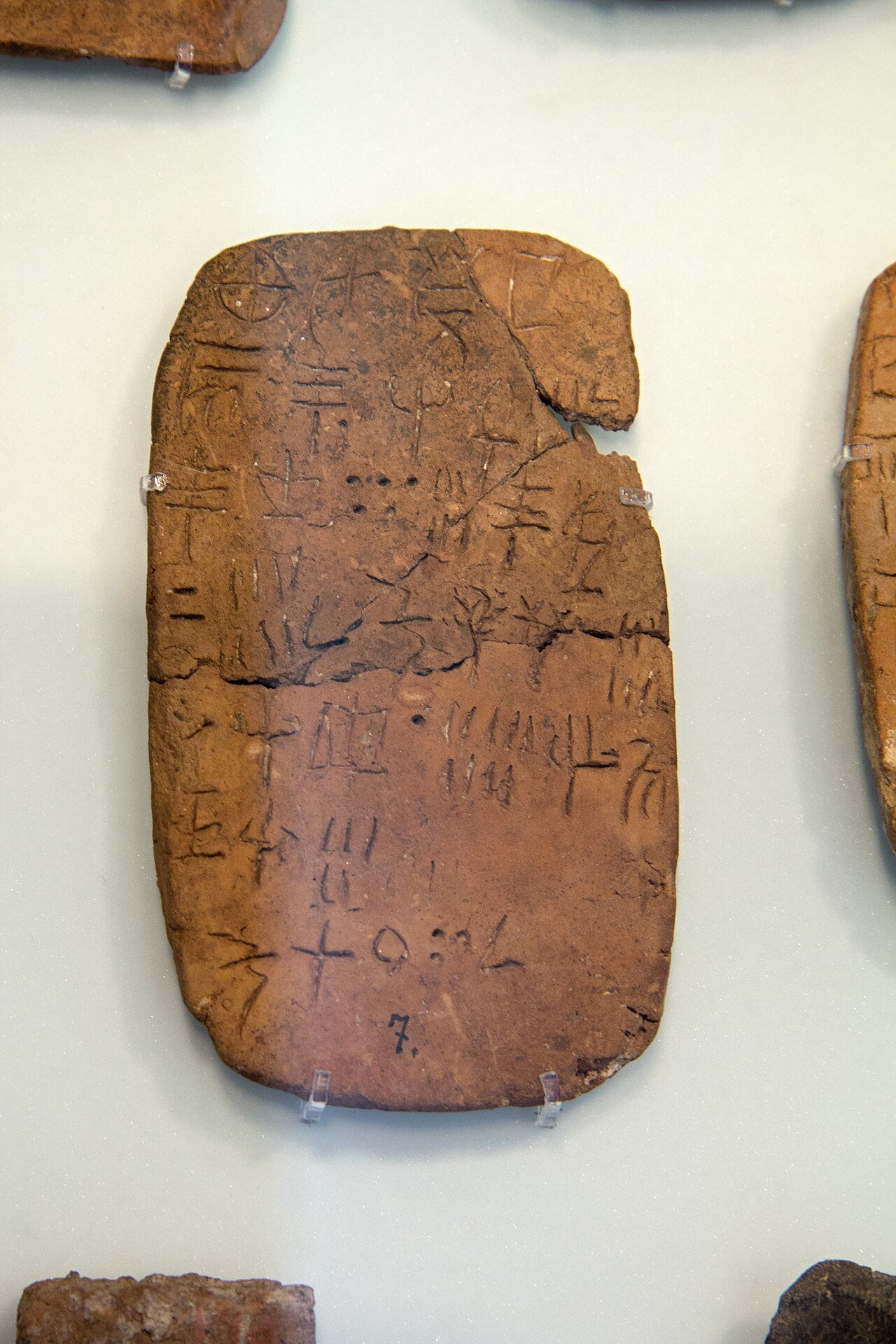
The Minoans used Linear A for palace accounts and religious objects, and it turns up on clay tablets, sealings, stone offering tables and even gold and silver hairpins. It shares many signs with Linear B, which Michael Ventris showed in 1952 to write an early form of Greek, building on Alice Kober's earlier work. Because the signs are alike, scholars can assign approximate sounds to most Linear A syllables. But the sounds produce words no one can interpret. The underlying Minoan language is unknown and fits no recognized language family.
Only about 1,400 inscriptions survive, roughly 7,400 sign tokens. Archaeologist John Younger has observed that the entire readable corpus would fill under two pages of typed text. Many entries are lists of names, goods and numbers, and no bilingual text has been found (Linear A). A 2024 review in Computational Linguistics surveyed the computational attempts on Linear A and its neighbors and found a field held back by how little digital data exists.
The Indus script (Harappan civilization, about 2600–1900 BC)
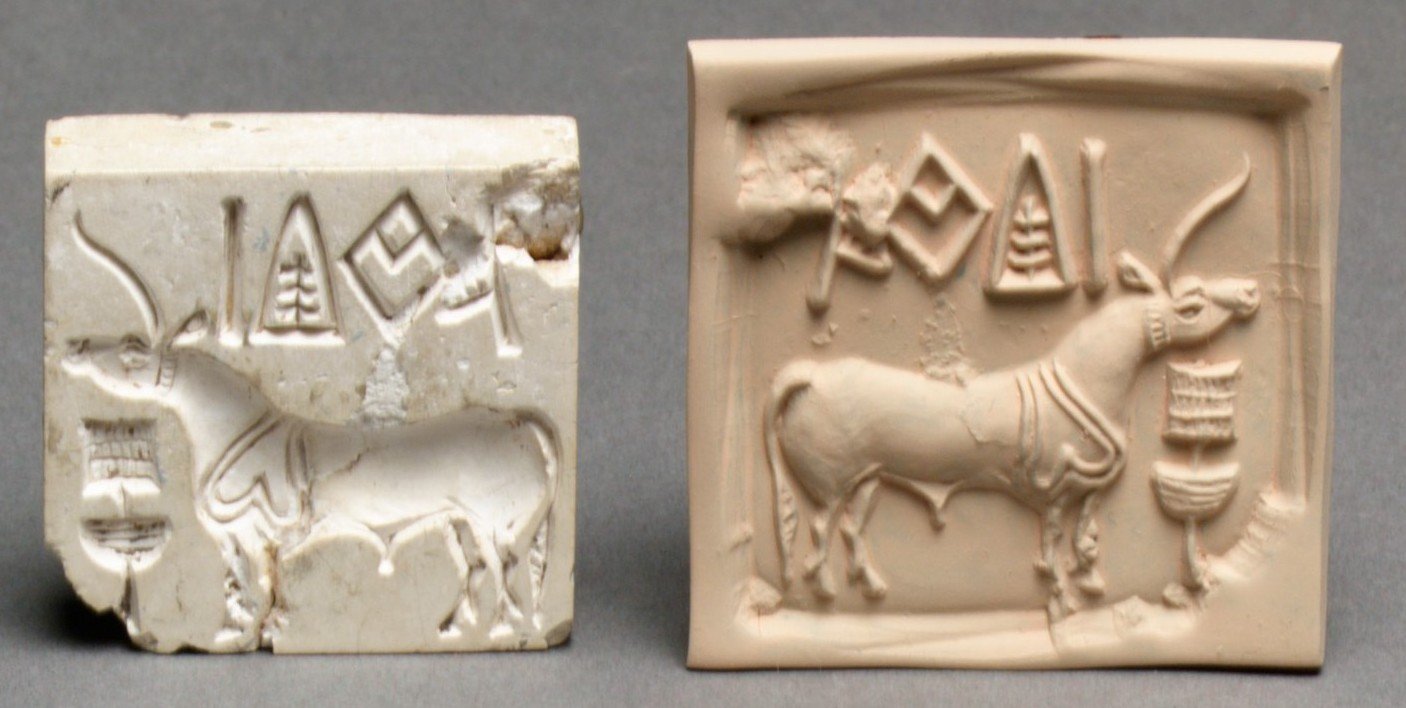
Indus signs appear on seals, pottery, tools and tablets across the Harappan world. About 4,000 inscribed objects were known by 1992, and about 5,000 had been reported by 2025, with more than 400 distinct signs. Most are small stamp seals only two or three centimeters on a side, and the average inscription is about five signs long. No bilingual inscription has been found (Indus script).
Some scholars doubt it records spoken language at all. In 2009 a team including Rajesh Rao reported that Indus sign sequences have statistical patterns resembling those of written languages (Science), and critics, notably Richard Sproat, disputed the method (Computational Linguistics, 2010). More than 100 decipherments have been published since the 1920s, and none has been verified. In January 2025 the Tamil Nadu government offered a US$1 million prize for a convincing one.
Rongorongo (Easter Island)
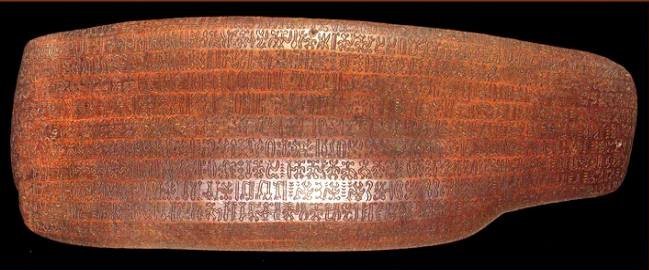
About two dozen wooden objects carry rongorongo, mostly tablets, plus a chieftain's staff, a statuette and two pectoral ornaments. All were collected in the late 19th century, and none remain on Easter Island. The glyphs, about a centimeter high, are outlines of people, animals, plants and geometric forms. The lines alternate direction, a layout called reverse boustrophedon: you read a line, then turn the tablet 180 degrees to read the next (Rongorongo).
Thomas Barthel published drawings of nearly the whole corpus in 1958. Apart from part of one tablet that appears to be a lunar calendar, with perhaps a genealogy, none of it can be read. The obstacles are few texts, no illustrations to give context, and a poorly recorded older form of the Rapa Nui language. Many scholars think it may be proto-writing or a memory aid. Statistical work, such as the Pozdniakovs' 2007 study, has helped sort basic signs from variants, but that is a catalogue, not a reading.
Proto-Elamite (Iran, about 3100–2900 BC)
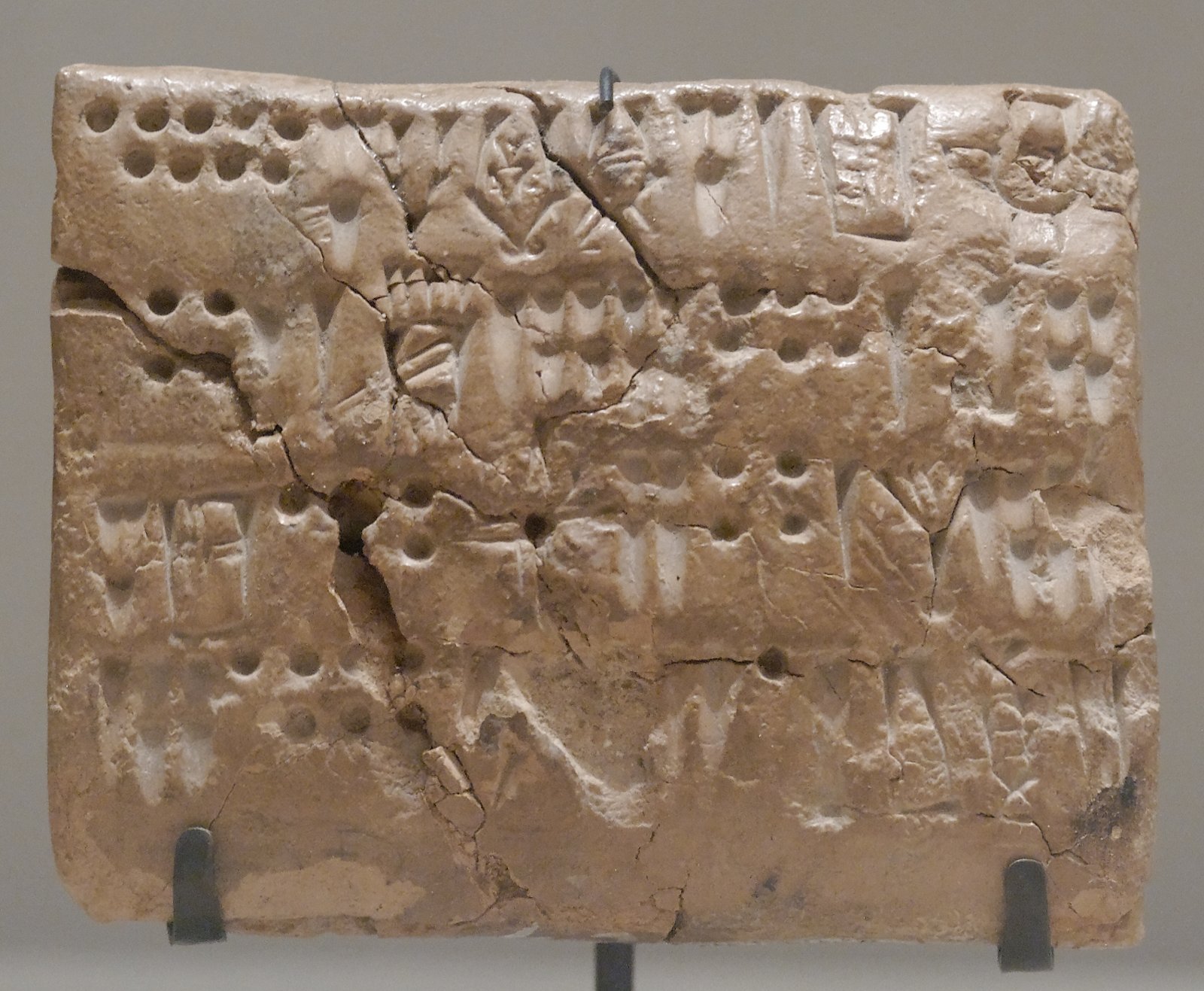
Proto-Elamite is the oldest known writing from Iran. About 1,600 clay tablets survive, most from Susa, and nearly all are accounts: goods, livestock and workers, each entry a sign followed by a number (Proto-Elamite script; Encyclopaedia Iranica). The numbers are partly understood, helped by similar tablets from Mesopotamia. Most of the other signs are not, and without a Rosetta Stone-style parallel text the language behind them is unknown.
Researchers have begun applying machine learning here. Logan Born, Kathryn Kelley and colleagues used clustering and topic models, then neural image-and-context models, to test which signs are really the same sign. That sharpens the sign list; it does not yet read the tablets.
There is real progress nearby. Linear Elamite, a later script from the same region, was proposed as nearly completely deciphered in 2022 by François Desset and colleagues, using silver beakers, published in 2018, that name rulers also known from cuneiform texts. Some specialists are waiting for detailed translations.
Cretan hieroglyphs and the Phaistos Disc
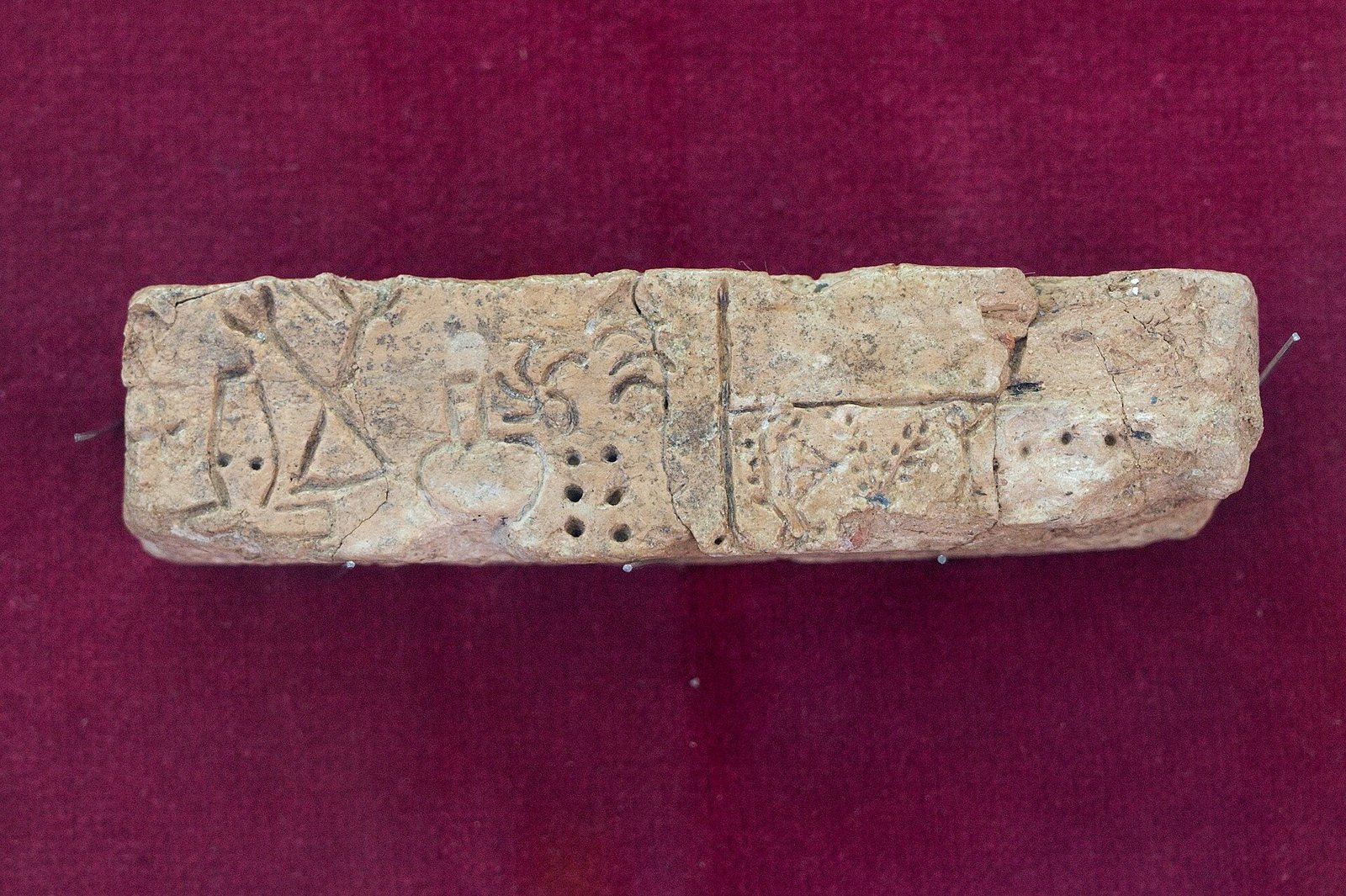
Cretan hieroglyphs were carved on seals and clay documents at Malia, Knossos and elsewhere from about 2000 to 1700 BC, roughly a century before Linear A. The standard catalogue lists just over 300 items, and the script is still undeciphered. One short, repeated sequence on many seals, the "Archanes formula," is the main proposed link to Linear A.
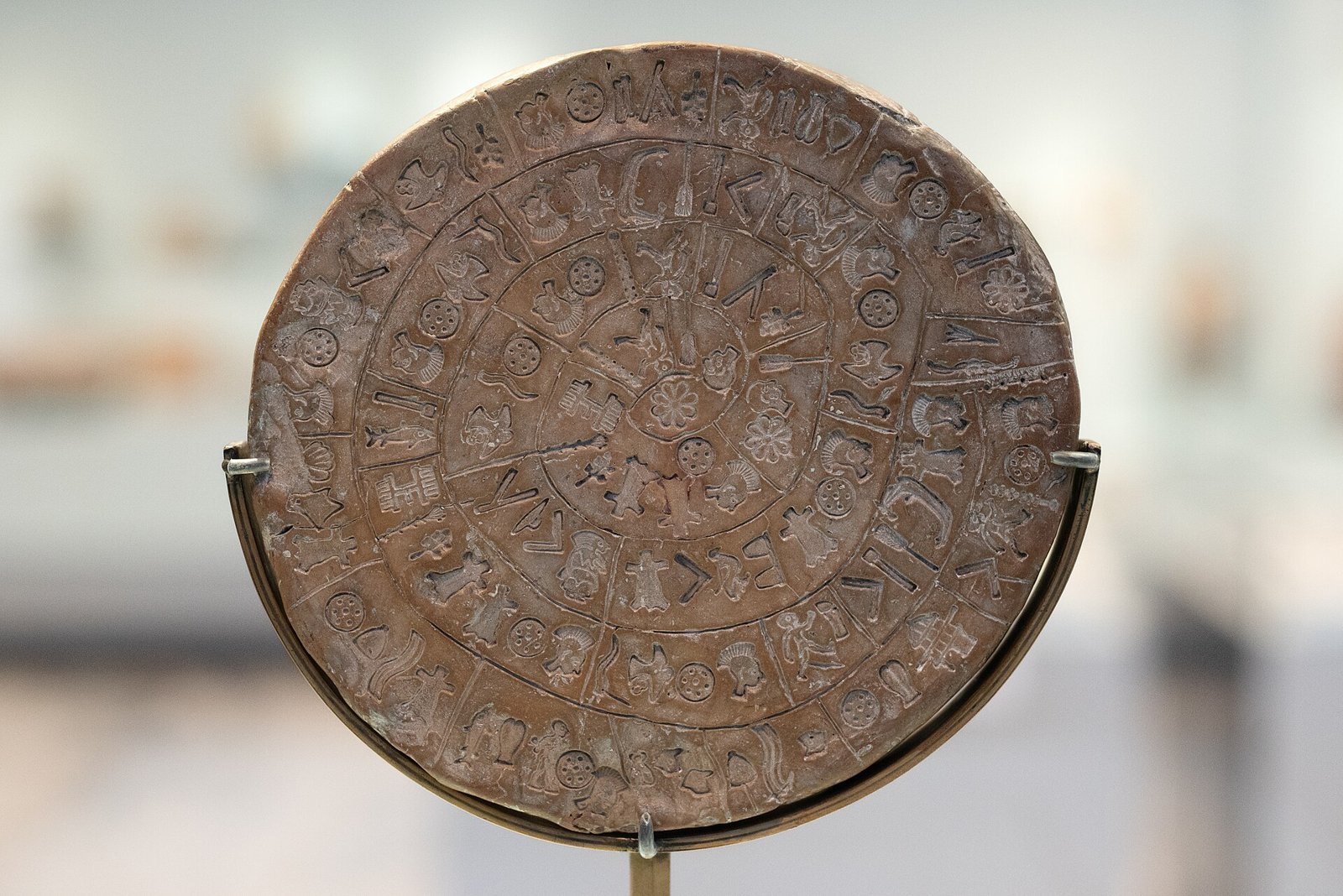
The Phaistos Disc is stranger. Luigi Pernier found it in 1908 in the palace at Phaistos. The fired-clay disc is about 16 centimeters across, with a spiral of signs on each side: 242 signs of 45 kinds, each pressed into the soft clay with its own stamp. Its date is uncertain, somewhere in the second millennium BC. No other object has been firmly linked to it, so there is nothing to compare it with, and scholars cannot even be sure it is writing (Phaistos Disc). The 2024 review above covers computational attempts on both scripts and runs into the same wall: inscriptions that are scarce and short.
The Voynich Manuscript (early 15th century)
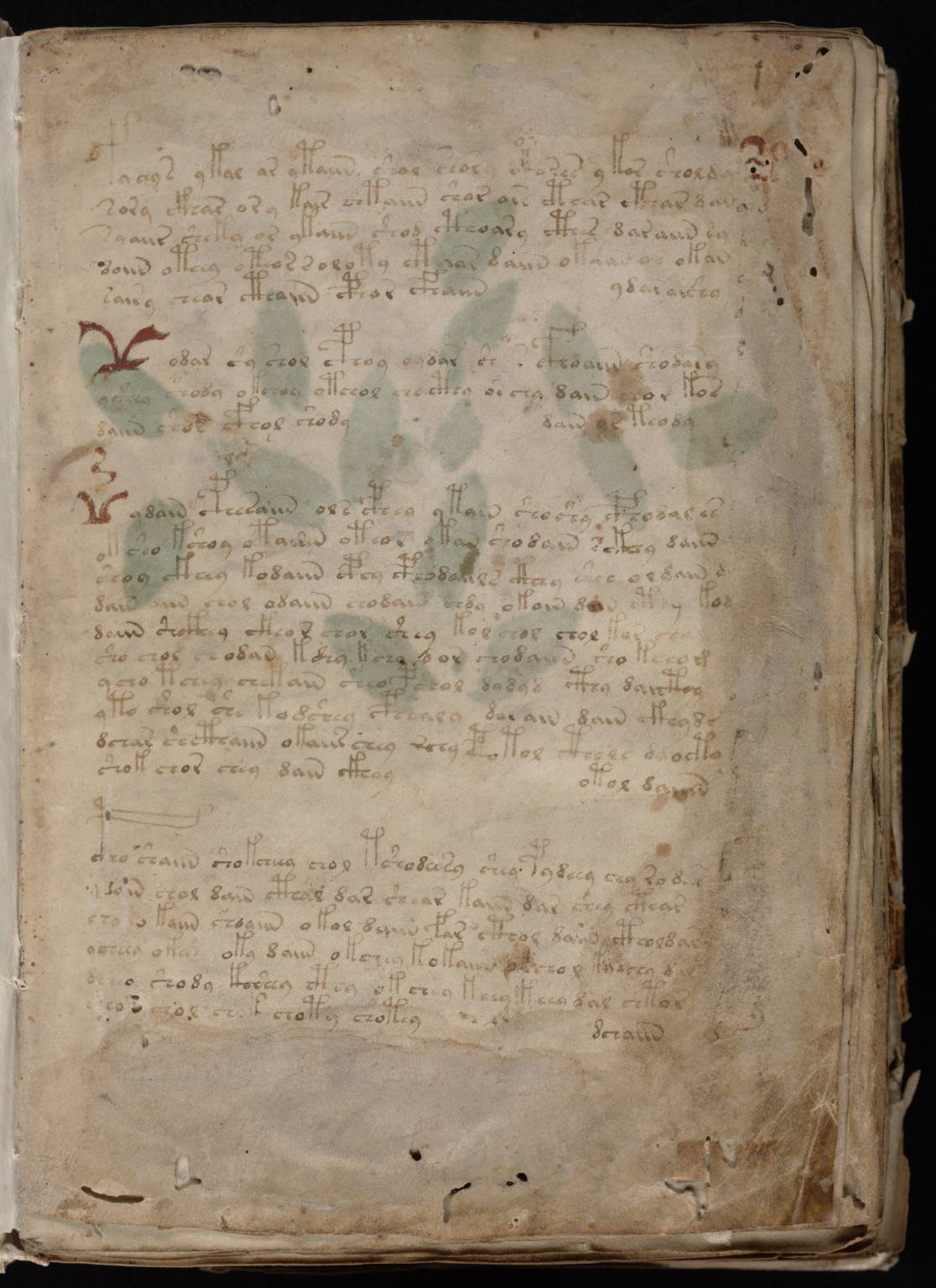
The Voynich Manuscript is a book of about 240 vellum pages in an unidentified script, illustrated with plants no one has identified, astronomical diagrams and bathing figures. Carbon dating places the vellum between 1404 and 1438. Wilfrid Voynich bought it in 1912, it has been at Yale's Beinecke Library as MS 408 since 1969, and Yale put the whole manuscript online in 2020 (Voynich manuscript; Yale Library).
Its roughly 170,000 characters behave a little like natural language, following Zipf's law, and a little unlike it. Famous codebreakers, including William and Elizebeth Friedman, failed to crack it. Yale's catalogue notes six sections of drawings, from plants and stars to baths, that hint at the content even though the text stays unread. Hypotheses range from a cipher, to an unknown language, to a hoax. New "solutions" keep appearing, including a 2017 computer-assisted claim that the text was scrambled Hebrew, but experts were not convinced. With no known text to check against, nobody can say which hypothesis is right.
Etruscan and Meroitic: readable letters, unreadable words
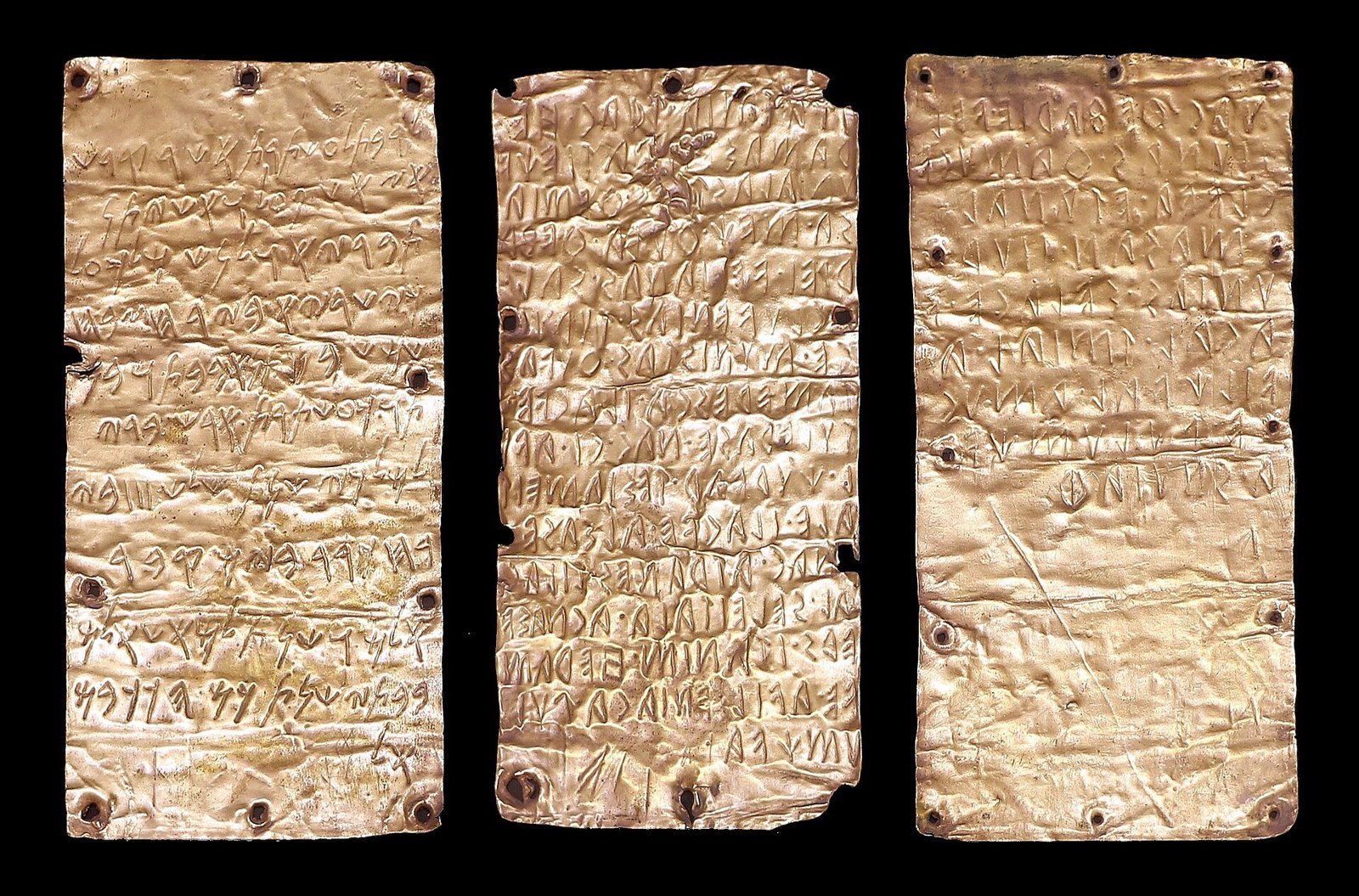
These two are a different case. We can read the letters aloud, but we understand little of what the words mean.
The Etruscan alphabet came from Greek, so its inscriptions can be pronounced. About 13,000 survive from roughly 700 BC to AD 50, most very short. The longest is the Liber Linteus, a linen book later cut up for mummy wrappings in Egypt, with about 1,200 readable words, mainly repetitive prayers, probably a religious calendar. The Pyrgi Tablets, found in 1964, pair Etruscan with Phoenician, but the Etruscan side has only 37 words and yielded one new word, "three" (Etruscan language).
Meroitic was the language of the Kingdom of Kush, in present-day Sudan, from about 300 BC to AD 400. Francis Llewellyn Griffith read its script in 1909 from the way it spelled Egyptian names, yet the language itself remains poorly understood because bilingual texts are scarce (Meroitic script).
What decipherment needs
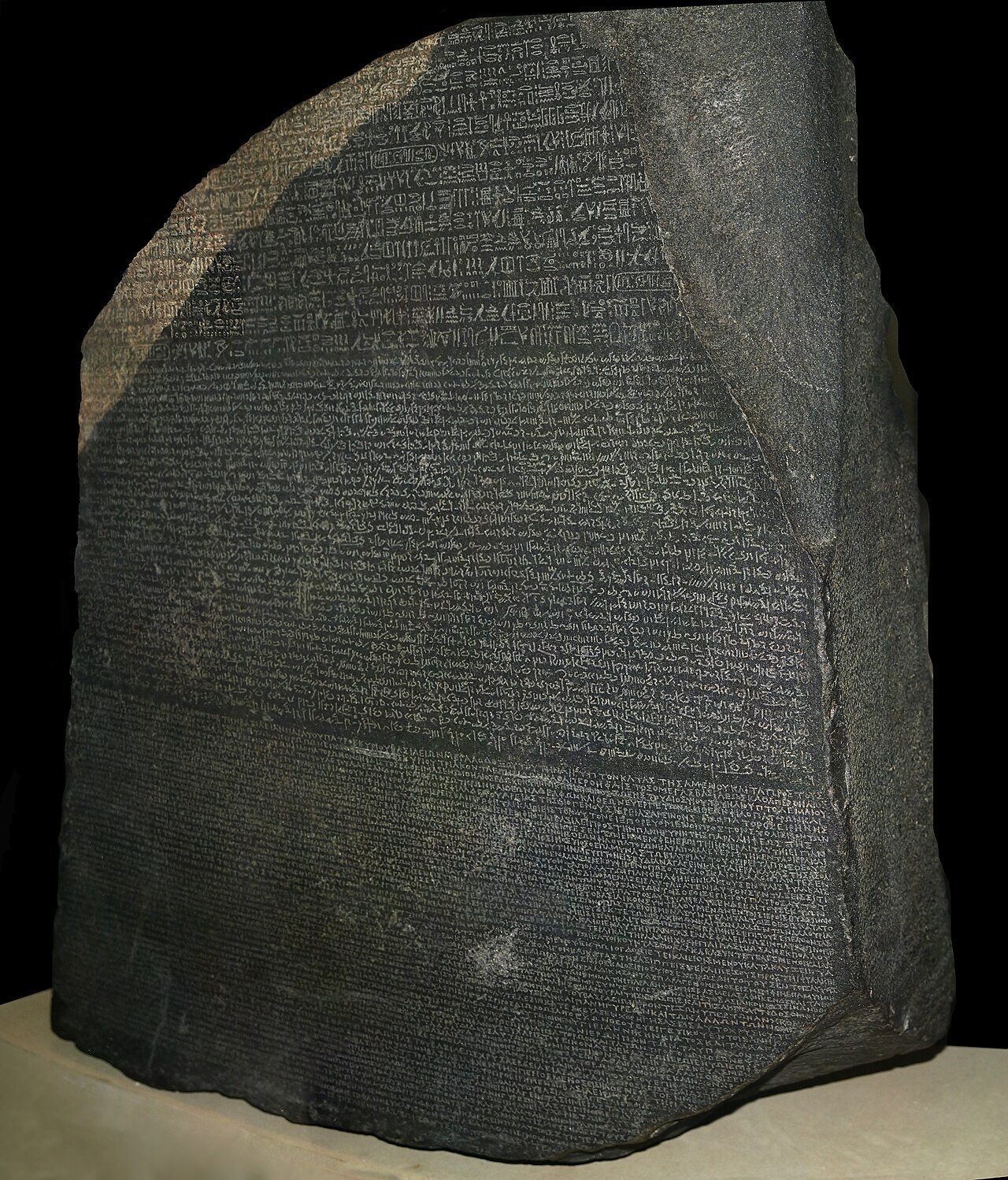
Across these cases the pattern repeats: too little text, and no translation beside it. The Rosetta Stone is the counterexample. It carries one decree from 196 BC in three versions, Egyptian hieroglyphic, Demotic and Ancient Greek. Scholars could read the Greek, so they had a key. It was found in 1799, and Champollion announced his breakthrough in 1822, building on Thomas Young's 1814 work on royal names in cartouches (Rosetta Stone).
Machines follow the same rule. A neural method by Luo, Cao and Barzilay matched Linear B words to their Greek cognates, correctly for 67.3% on a hard dataset and 84.7% on a cleaner one (as summarized in the 2024 review). That worked because Greek was already known. With enough text and a key, decipherment is a matter of work. Without them, even great computing power has little to hold on to.
The lesson for archives: send the key with the message
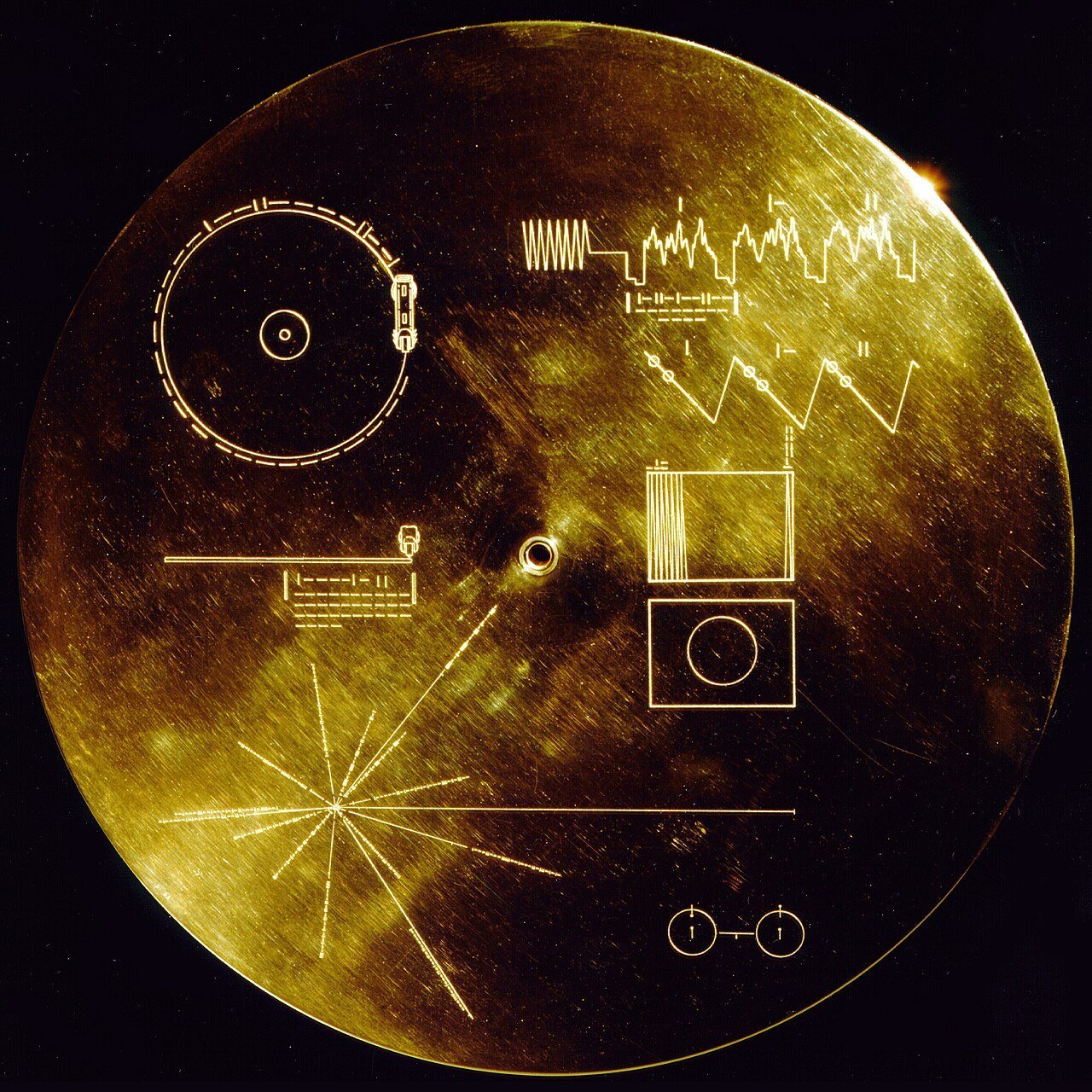
The designers of the Voyager Golden Record faced this problem by design, because whoever finds it will share no language with us. The content of the record is hidden in frequencies. Its sounds, and its pictures too, are encoded as analog signals in the grooves, and the pictures are stored as a video-like signal that has to be traced out one line at a time. Nothing on the record can be read by eye. So the designers put the key on the cover, as diagrams. According to NASA, a drawing of the record and stylus shows how to play it from the outside in. Around it, in binary, is the time of one rotation, 3.6 seconds, in units of 0.70 billionths of a second, the time associated with a fundamental transition of the hydrogen atom. Another set of drawings shows how to turn the recorded signal into pictures made of 512 vertical lines, and includes the first picture so the finder can check the result. A pulsar map places the solar system among 14 pulsars with their periods. The frequencies hold the content, and the cover holds the key.
Digital storage works the other way. A file is a string of ones and zeros, and its meaning lives in the codec, the format and the software. Lose those, and the bits are as silent as Linear A. The key is the specification: the published standards, such as those of the IEC, that define each format and digital channel. Without them, digital data becomes an undeciphered script. I have lived this. I digitized my family's photo albums, then moved them from floppies to Zip disks, CDs, DVDs, Blu-ray and hard drives that failed, and today I can't open some of the photos I stored twenty years ago. The popular idea that digital is the final resting place for our knowledge will not hold over centuries.
NanoFiche: human-readable, with the key beside it
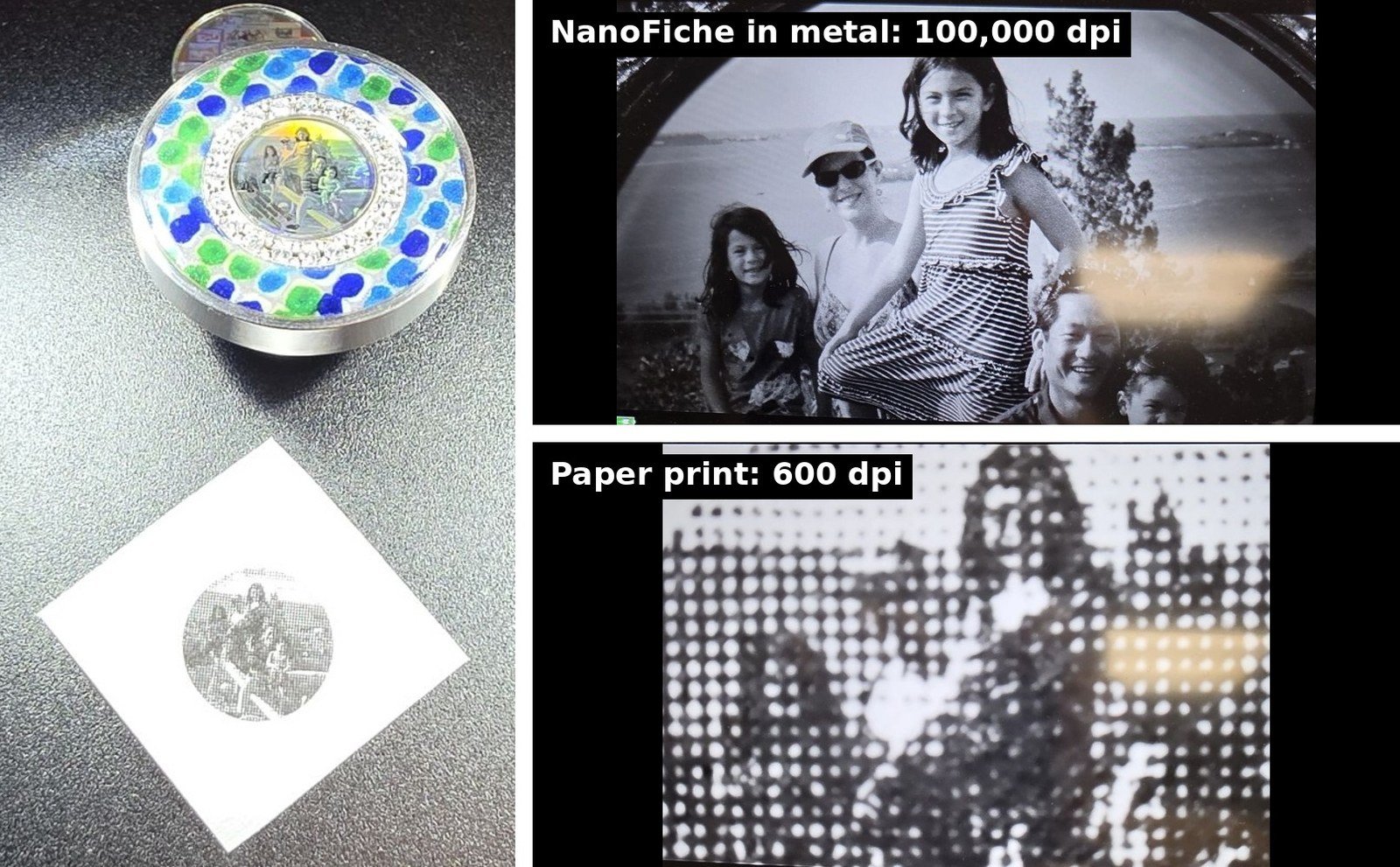
NanoFiche takes the opposite approach. We engrave the actual pages and pictures, human-readable, into solid nickel. To read one you need light and a microscope: no power, no software, nothing to migrate or plug in. A NanoFiche the size of a dime typically holds about 1,000 pages (nanofiche.com). If the digital copy is ever lost, the nickel can be scanned to make a new one.
Like the Golden Record cover, our archives use pictures and universal references so that a reader with no shared language can find a way in. I believe the keys to decode are those specifications, the IEC and similar standards for the various formats and digital channels, and that an archive should keep them beside the content in a form people can read without any equipment. Whatever carries the data, the specification that explains it should be as durable as the data. That is why I think they belong in technology-agnostic analog glyphs, readable the same way the pictures are. Our 30-million-page Lunar Library flew on the Beresheet lander in 2019. The lander crashed, but the library is believed to have survived on the surface (From Saigon to the Moon).
Conclusion
Every script on this list was once perfectly readable to the people who used it. What was lost was the key, not their intelligence. The lesson for any archive is to keep the knowledge and the means of reading it together, in a form that does not depend on any one technology. The idea is simple: archive it once, and then you're done.
Preserve your legacy forever.
Follow NanoFiche on LinkedIn: https://www.linkedin.com/company/nanofiche/
#DigitalPreservation #Archives #AncientHistory #NanoFiche
Image credits
- Linear A tablet, Hagia Triada. Zde. CC BY-SA 4.0 (attribution required, share-alike), via Wikimedia Commons. Resized to 1280 px wide.
- Indus stamp seal and impression. The Metropolitan Museum of Art (Open Access), acc. 49.40.1. CC0, via Wikimedia Commons.
- Rongorongo Tablet B verso. Unknown author. Source: Catherine Orliac and the Congregation of the Sacred Hearts of Jesus and Mary. Public domain (PD-script), via Wikimedia Commons. Low resolution (649 px).
- Proto-Elamite tablet, Susa. Marie-Lan Nguyen (2009). CC BY 2.5 (attribution required), via Wikimedia Commons. Resized to 1600 px.
- Cretan hieroglyphic inscription, Petras. Zde. CC BY-SA 4.0, via Wikimedia Commons. Resized to 1600 px.
- Phaistos Disc, side A. Gleb Simonov. Public domain (Commons tags CC0 and PD-Art), via Wikimedia Commons. Resized to 1600 px.
- Voynich Manuscript page. Beinecke Library, Yale University; author unknown. Public domain (PD-Art, PD-old-auto-1923), via Wikimedia Commons. Original size.
- Pyrgi Tablets. Sailko. CC BY-SA 4.0, via Wikimedia Commons. Resized to 1600 px.
- Rosetta Stone. © Hans Hillewaert. CC BY-SA 4.0 (credit "© Hans Hillewaert"), via Wikimedia Commons. Resized to 1280 px wide.
- Voyager Golden Record cover. NASA/JPL. Public domain (PD-USGov-NASA), via Wikimedia Commons. Resized to 1280 px.
- Paper vs. NanoFiche comparison. NanoFiche / Bruce Ha (own image from his Nov 16, 2026 LinkedIn post). Own work. Resized to 1600 px; approved by Bruce.


Sources
- Linear A: https://en.wikipedia.org/wiki/Linear_A ; https://en.wikipedia.org/wiki/Linear_B ; https://aclanthology.org/2024.cl-2.7/ (Braović et al., 2024)
- Indus script: https://en.wikipedia.org/wiki/Indus_script ; https://www.science.org/doi/10.1126/science.1170391 ; https://aclanthology.org/J10-3012.pdf ; https://www.thehindu.com/news/national/tamil-nadu/tamil-nadu-cm-stalin-announces-1-million-prize-for-deciphering-indus-valley-script/article69064187.ece
- Rongorongo: https://en.wikipedia.org/wiki/Rongorongo ; https://hal.science/hal-01389639
- Proto-Elamite and Linear Elamite: https://en.wikipedia.org/wiki/Proto-Elamite_script ; https://www.iranicaonline.org/articles/elam-iii/ ; https://aclanthology.org/W19-2516/ ; https://aclanthology.org/2023.cawl-1.11.pdf ; https://doi.org/10.1515/za-2022-0003
- Cretan hieroglyphs and the Phaistos Disc: https://en.wikipedia.org/wiki/Cretan_hieroglyphs ; https://en.wikipedia.org/wiki/Phaistos_Disc
- Voynich Manuscript: https://en.wikipedia.org/wiki/Voynich_manuscript ; https://beinecke.library.yale.edu/collections/highlights/voynich-manuscript ; https://www.theverge.com/2018/2/1/16959454/voynich-manuscript-mystery-ai-decoded-debunked
- Etruscan and Meroitic: https://en.wikipedia.org/wiki/Etruscan_language ; https://en.wikipedia.org/wiki/Meroitic_language ; https://en.wikipedia.org/wiki/Meroitic_script
- Rosetta Stone: https://en.wikipedia.org/wiki/Rosetta_Stone
- Voyager Golden Record: https://science.nasa.gov/mission/voyager/golden-record-cover/ ; https://en.wikipedia.org/wiki/Voyager_Golden_Record
- NanoFiche facts: https://nanofiche.com/ ; https://nanofiche.com/from-saigon-to-the-moon-why-i-built-nanofiche/