People usually meet me at a booth, squinting into a microscope at a nickel disc and asking how a whole library fits on a coin. The better question comes next: why would anyone spend their life on this? The honest answer starts on a river in Vietnam.
The morning we left
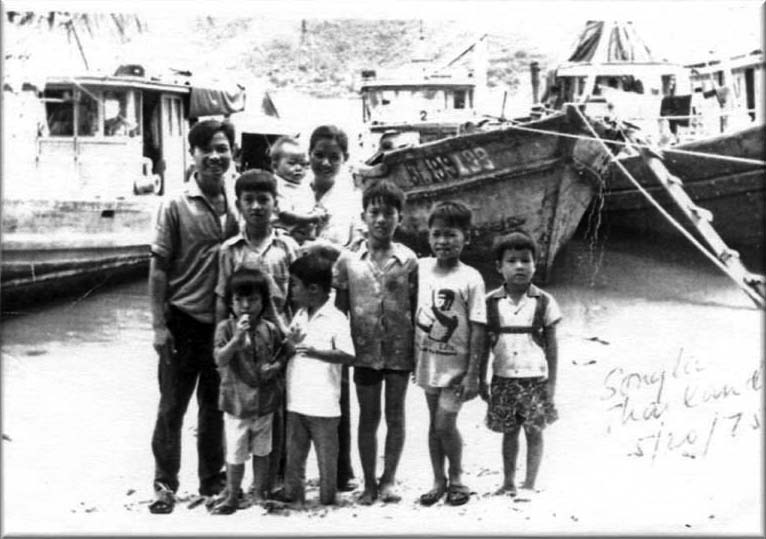
My father worked for the government in South Vietnam, and my mother was a teacher. There were seven of us kids. In 1975, as Saigon was about to fall, it became clear that a family like ours could not stay. A plan to fly part of us out fell apart when Saigon's main airport was bombed the day before. My father and a friend had bought a small boat together, and on the morning of April 30, 1975, all nine of us went for it. I was nine years old when we left, and I had turned ten by the time we reached America.
The boat was built for about 20 people. By the time we pulled away down the Saigon River there were about 100 on board, and the tanks were coming into the city behind us. We got out just in time.
Here is the part that shaped everything I've done since. My father took gold, jewelry and money. My mother took a little food for my baby brother, who was one year old, and she took the family photo albums. Along the way nobody would take our money, so the gold and jewelry went to buy food. We gave away a lot of precious things. The photos we kept.
We gave a lot of precious stuff away. But what was most precious to us were the photos.
We spent about ten days at sea, so seasick I couldn't eat the rationed food. On the ninth day a typhoon was coming and the men bailed water all night. In the morning Thai boats towed us in, and that night the full storm hit. We were so lucky to survive.
Starting over in California
We lived in refugee camps for months. My father, who had been a dignitary, had to ask for food to keep us alive, and because he had his papers he got us to Camp Pendleton in California. We were still homeless, but to me it was paradise. I found one stick of Wrigley's mint gum, still in its wrapper, and I made it last by nibbling a little every day.
A Baptist church sponsored us and rented a house so my parents could work and pay the rent. It was a 1,200-square-foot, three-bedroom home in Newbury Park, and nine of us lived there. It was ours, and we were safe.
We had a year of school to make up. I taught myself English partly by watching Get Smart and The Love Boat. Around then I also picked my American name. My idol was Bruce Lee, so I became Bruce.
How a pre-med kid fell for engineering
In a traditional Asian family with a teacher for a mom, the choices were doctor or engineer. My older brother went to USC, earned his medical degree at UCLA and went on to Columbia, and I meant to follow him. Then, in high school, a Rockwell Science Center internship put me in a gallium arsenide group designing circuits, and I went down the technology rabbit hole for good. I wrote code on TRS-80s and an Apple IIc, took Fortran at the local college and helped my high school teacher teach it. My first real gadget, an HP-41C calculator, is probably still in my basement.
I wanted to fly, but my nearsightedness ruled that out. So I went to USC for electrical engineering, with a minor in business, and stayed for a master's in electrical engineering focused on optical communications. Then I went to work in aerospace and defense at Hughes Aircraft and Raytheon, on radar and missile systems.
Twenty years of storing the world's information
Storage was what really pulled at me. For Pioneer I spent two years doing laserdisc R&D in Japan, a fantastic experience, then five years at the laserdisc plant we built in Carson, California. At Technicolor we started a CD facility, and they put me on the consortium that worked out the specifications for the DVD. Along the way I also developed the first flexible optical trading card, for Upper Deck.
A former Technicolor manager who had moved to Eastman Kodak called me about a problem there. Kodak and Intel were creating a new format called Picture CD, and burning each disc took about 20 minutes. I came in with a new process and a set of inventions that took it from 20 minutes to five seconds, so Kodak could make millions of discs a month. We got it to market in eight months, and that work is what brought me to Rochester in 1998.
When Kodak began divesting, I partnered with a Canadian VHS maker to buy the division and keep its people working, and we turned a $3 million deficit into a $3 million profit. But VHS was dying, my partner pledged our joint company's assets to his bank, and I lost the fight in court. So I started over on my own.
Stamper Technology, and a very small way to write
I incorporated Stamper Technology here in Rochester in 2006 and set up at 232 Wallace Way. I had bought a laser writer from Kodak, and I rebuilt it to write extremely fine detail very fast: 300,000 dots per inch, where a typical office printer does about 600. The first big job for it was security. To fight disc counterfeiting, I developed a 300,000 dpi holographic authentication feature that has been licensed for use on Microsoft Windows, Office and Xbox discs made since 2007. That process is covered by four U.S. patents granted between 2010 and 2014. Counting my earlier work at Kodak and the jewelry patent, I'm a named inventor on 12 U.S. patents.
Then a request came in to write the King James Bible onto a disc the size of a quarter. I fit it on something smaller, with room left over for a cross. My wife, Sarah, saw it and asked if I could put a few Bible verses on a pendant for her. I put all of them on, roughly 31,000 verses, because there was room. She wears it every day. Friends wanted them for graduations and confirmations. In 2013 that became NanoRosetta and the Sarah Ha jewelry line, named for her.
Why the photos still matter
Those albums my mother carried out of Saigon had been dropped in the ocean. The pages were torn and the pictures were fading. So I did what an engineer does and digitized everything. Then I spent years moving it from floppies to Zip disks, CDs, DVDs, Blu-ray and hard drives that failed, with connectors that kept changing. Every new format meant carrying the old files forward. Today I can't open some of the photos I stored digitally twenty years ago.
People think you put it in the cloud and it's forever, but it's really ephemeral.
That's the problem NanoFiche solves. Instead of ones and zeros that need the right software and hardware to decode, NanoFiche engraves the actual pages and pictures, human-readable, into solid nickel. To read it, you need light and a microscope. There's nothing to migrate and nothing to plug in, and nickel shrugs off water, heat and radiation.
Taking it to the Moon
I grew up on science fiction, and Asimov's Foundation trilogy is still my favorite. So when I read that the Arch Mission Foundation had sent the Foundation books into space on a quartz disc, I contacted its founder, Nova Spivack, and sent him the same content on a small nickel disc you could read with a microscope. That started a long partnership. I am technology advisor (formerly chief scientist) at Arch Mission Foundation.
In 2019 our 30-million-page Lunar Library flew on SpaceIL's Beresheet lander. Beresheet crashed, but the library is believed to have survived on the surface. Since then NanoFiche has flown on Astrobotic's Peregrine, which never reached the Moon, landed on Intuitive Machines' Odysseus in February 2024, and landed upright on Firefly's Blue Ghost in March 2025. Not every mission went as planned, and I'd rather tell you that straight. Next, Astrobotic's Griffin-1 is set to carry AstroGLPH, a lunar library that includes work from RIT here in Rochester. On Earth, copies are held by the Smithsonian National Air and Space Museum, the Long Now Foundation and the Allen County Public Library, among others.
The idea is simple: archive it once, and then you're done.
Where we are now
This year we joined the Society of American Archivists and exhibited at RootsTech and the SAA annual meeting. We've also been proving the other half of the promise, getting the information back out. In a blind test, we recovered all 2,026 pages of a Vedabase medallion at 99.8% character accuracy, and this month we scanned an engraved 911 NanoFiche and turned it back into a searchable 163-page PDF in under a minute.
At home, my wife and I raised three daughters, and our family has practiced Taekwondo together. I've been blessed with a lot, and I want to give some of it back. To me that means making sure the next generation can still read who we were.
Let's keep your story
In 1975, my mother made a choice in a hurry about what was worth saving. If you're an archivist, a librarian, a family historian, or just someone holding a box of photos you can't bear to lose, I'd love to show you what NanoFiche can do. Explore the gallery, read about our missions and news, or get in touch.
— Bruce Ha, founder and CEO, Stamper Technology and NanoFiche, Rochester, New York